End of Exercise Study and Tooth Fairy

Our focus question for the week was what jobs are related to exercise?  Here are our answers:

“Working at a gym” – Madeleine

“A yoga instructor” – Abbi

“Being a football player” – Collin

“A coach” – Townes

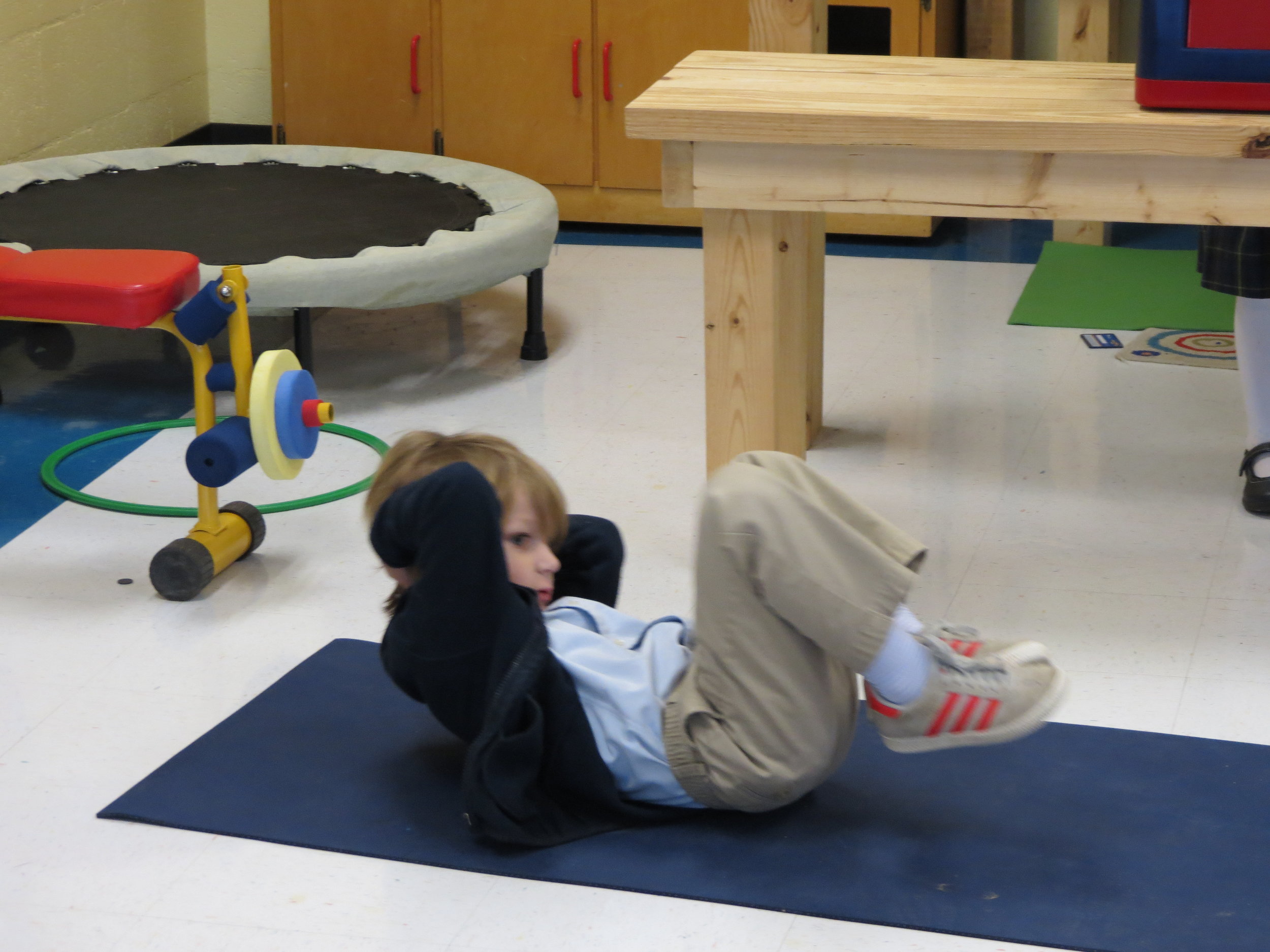
Our exercise study is coming to an end, but we have had special visitors come and do some exercising with us.  Mrs. Summer, Colin’s mom, came and did a seven minute workout with the children.  She told them that she does not get to go to the gym every day, but has an app on her phone that allows her to be able to exercise from anywhere.  We also had Kara, a yoga instructor from FWDFIT, and Anna Scott’s mom, Monica, come and talk to the boys and girls about the benefits of yoga, and showed them the cat, cow, downward dog, tree and puppy pose.  Thank you Kara, for taking the time to come share your expertise with us!

We read Bear Feels Sick by Karma Wilson and Max by Rachel Isadora.  Here are the new vocabulary words we learned:  autumn, heap, wheeze, badger, wren, coax, smidgen, quivers, fret, and frolic.  Learning new vocabulary is important because literacy development is influenced by explanatory talk such as discussion of cause-and-effect relationships and connections between ideas, events, and actions.  Children’s later literacy development also is influenced by their ability to define words and their knowledge of grammar.   

We learned all about the letter K and number 18. We added kiss, KayKay, kangaroo, knife and kid to our word wall.  The children traced Kk, and did the K page in their Handwriting Without Tears books.  I added plastic knives to the playdough center so the children could practice their cutting skills.

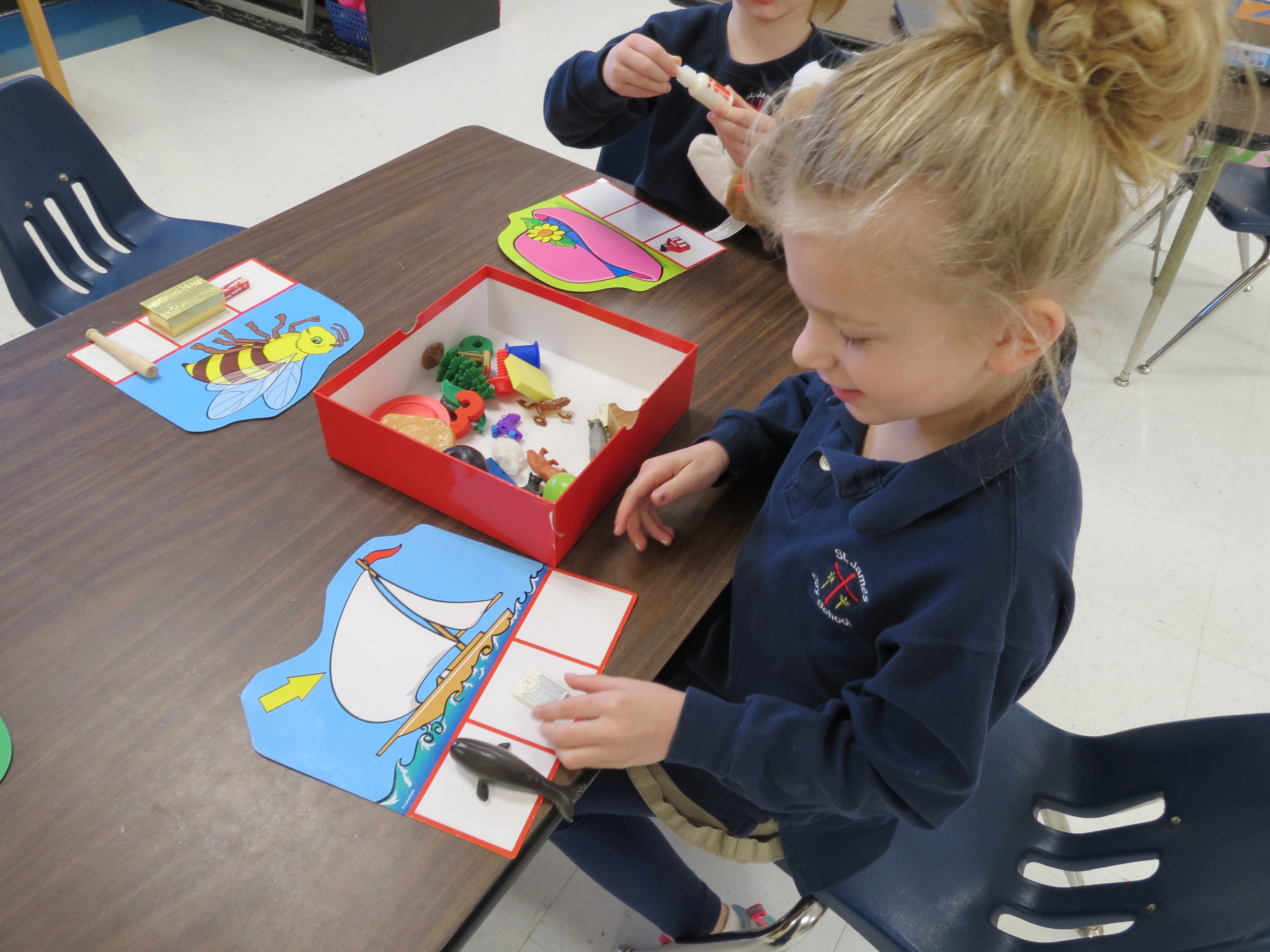
We worked on our rhyming skills this week.  Each child was given a card of an object, i.e., shoe, gate, boat, sled, bear, hat, sock, bee, and thumb.  The children had to find three objects in a box that rhymed with their picture.  This activity helps with phonological awareness.  Phonological awareness is the ability to discern the sounds and patterns of spoken language.  Phonological awareness is an important skill in learning to read.  Children typically begin to demonstrate this awareness by about age three, and their skills improve gradually over many years, and it is a strong predictor of later reading, writing, and spelling ability.

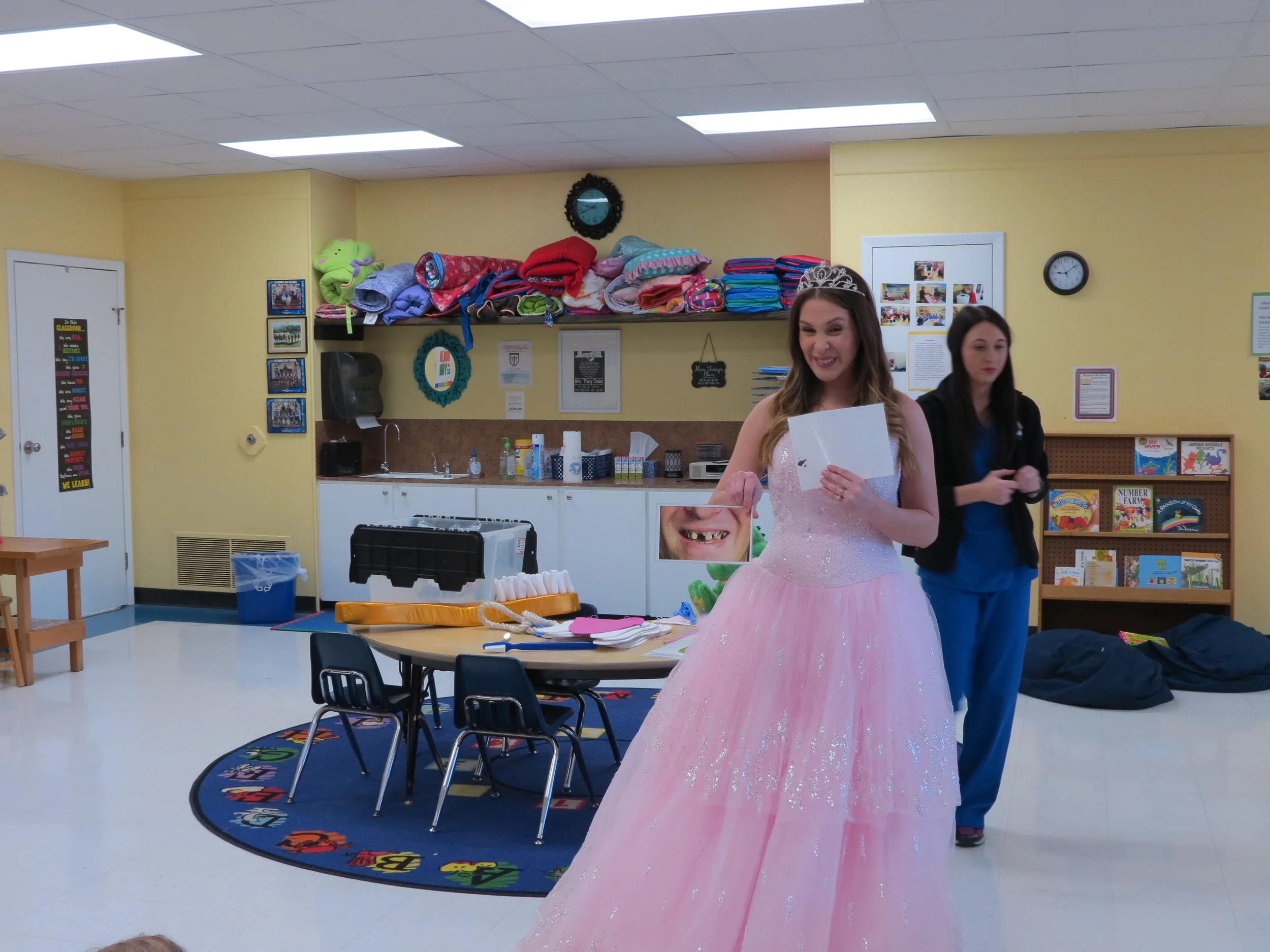
We had a special visit from Twinkles, the tooth fairy.  She talked to the children about the importance of dental health.  She said that they should be brushing their teeth twice a day for two minutes.  She also said that they should brush in a circular motion and brush up and down on their tongue.  She talked to them about what sugar can do to your teeth if they are not brushed properly.  Each child received a goody bag to take home.  A special thank you to Dr. Glass and Dr. Bunch for providing this service. 


Tracy Jones
Guacamole, Graphing and Geoboards

Our focus question for the week was what do our bodies need in order to move and exercise?  Here are our answers:

“Water” – Emily

“Vegetables” – Abbi

“Salad” – Madeleine

“Fruit” – Emily

We read Rah, Rah, Radishes A Vegetable Chant by April Pulley Sayre and Guacamole by Jorge Argueta.  I absolutely love bringing a book to life for the children.  We made our own guacamole after reading the book.  The children loved this activity and this helps with their comprehension and response to books and other texts.  Comprehension, the process of finding meaning, is the goal of reading instruction.  Comprehension of oral language and simple texts is essential to future reading success; children learn to process what they hear and read.  Children who engage in frequent activities with books have larger, more literate vocabularies.  These children learn to read better than children who have few book experiences. 


We learned all about the letter B and number 16.  We added dry beans, scoops, measuring cups and shovels to our sensory bin.  The children were able to fill, dump, transfer, sort and count the beans!  The children water colored a boot, traced Bb, and did the B page in their Handwriting Without Tears books.  They also colored and cut out bats to hang from the ceiling in our science center. 


In our science center we added a skeleton (Mr. Bones) so we could study and examine the bones.  We learned that the human body has 206 bones, and learned the names of a few in the human skeleton.


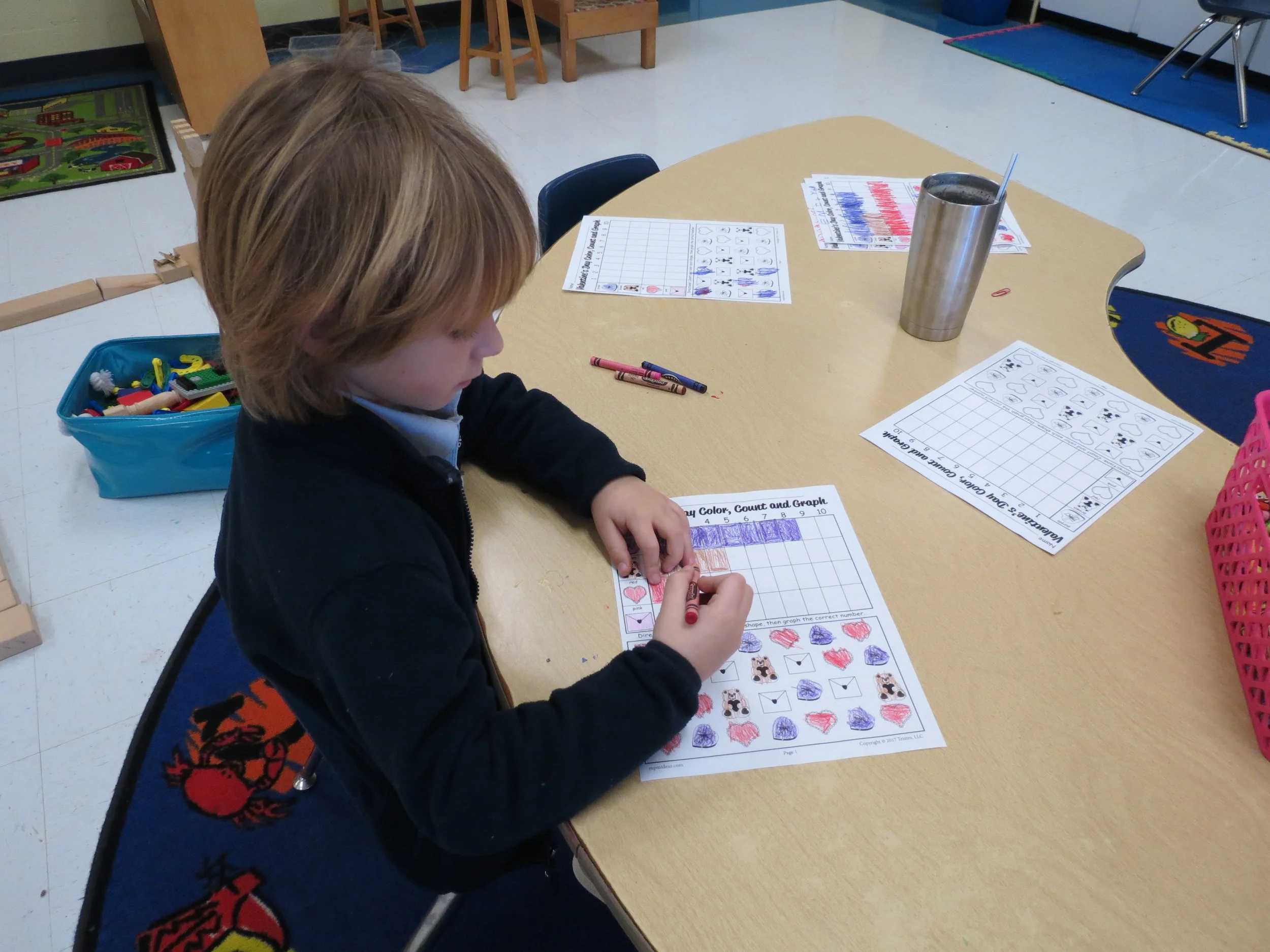
The children colored, counted and graphed hearts in math, and got to use geoboards also.    Being able to graph is so important because it teaches them how to use number concepts and operations.  Children’s understanding of counting, number symbols, and number operations are fundamental to their success with more complex mathematics.  To count well, children must learn the verbal number sequence, one-to-one correspondence, i.e., that one number name is matched to a single object in a set being counted, and cardinality, i.e., that the last number named when counting objects tells how many.   Playing with a geoboard is helping with spatial relationships and shapes.  Understanding spatial relationships and shapes helps children build the foundation for understanding geometry. 

Tracy Jones
Exercise, Math and PE

We started our exercise study on Monday.  Why investigate exercise?  Our bodies are made to move.  Young children are in nearly constant motion when they are awake.  They wiggle, stretch, bend, jump, hop, bounce, and climb.  Moving makes children feel capable and confident, releases tension, and builds strong bodies and minds.

This study begins with children’s natural desire to move.  A study of exercise not only offers opportunities for children to explore a topic that interests them, but also enables them to gather information, become more aware of the world around them, and solve problems.  Children will explore many types of exercise, observe people while they are exercising, and learn about the mechanics of movement and how to use special equipment to stay safe when exercising.  They will also learn about nutrition and jobs related to exercise, and the connection between exercise and healthy bones and muscles.  They will gather data, meet interesting people, explore a variety of challenging exercise movements, and prepare energizing snacks.  A study of exercise offers a meaningful way for children to use literacy, mathematics, the arts, and technology to investigate and represent their understanding of important concepts related to physical development, science, and social studies.

Our focus question for the week was what do we know about exercise?  Abbi said “you can jog for exercise.”  Townes said “people exercise to get stronger.” Piper stated “you can use a treadmill to get exercise.”  Our home living center has been turned into a gym.  We added a trampoline, weight bench, hula hoops, and yoga mats. 

We learned about the number fourteen, and all about the letter D.  We read about Dinah the Dinosaur and the sound she makes.  We water colored Dottie the Dinosaur, traced and wrote our own Dd and practiced drawing diamonds!

We read The Happiest Tree a Yoga Story by Uma Krishnaswami.  We learned the following vocabulary words:  improved, clumsy, performance, rehearsal, topple, sets, India, astonishment, cloak and snagged.  We also read We All Went on Safari A Counting Journey through Tanzania by Laurie Krebs.  We learned some fun facts about Tanzania, and counted to ten in Swahili.

We are learning about symmetry in math.  The children were given sheets with half of a butterfly and tadpole.  They were told to make the pictures match, to copy the lines to make the picture symmetric.  I explained that symmetry means for both sides to look exactly the same.  With this activity the children were introduced to a topic (symmetry) that will be discussed in their math classes from now until college; and depending on which career they choose, even longer.  Symmetry is found everywhere in nature and is also one of the most prevalent themes in art, architecture, and design.  It seems to be such a small aspect of the study of Geometry, however it is an integral component connecting Mathematics to the real world.  Children have a natural interest in finding balance, what better way to feed that curiosity than by teaching a basic understanding of symmetry?

IMG_5601.JPG

Students were able to explore dance and movement concepts using scarves in PE.  One of the first ways that children express themselves is through movement.  Each new movement gives children more information about the capabilities of their bodies.  Preschool children demonstrate knowledge of dance and movement in many ways when they use scarves as they respond to music.  Movement, taught with pretend imagery, is beneficial to children’s learning and enjoyment of dance.  Coach Nicole also introduced jumping rope, and this helps with their balancing skills.  Balancing involves movements to help stabilize the body’s position when the person is not a rest.  Jumping rope requires balance.  Balancing is difficult for young children because of their uneven body proportions.  As children become less top heavy, their ability to balance improves. 


Tracy Jones
PreK Presents the Nativity Story

St. James Day School PreK had our Christmas Program on Thursday, December 7, at St. James Episcopal Church. This time of year it is easy to get caught up in the rush of the Christmas holiday and lose focus on what is the true meaning of Christmas. The children were able to share the Nativity story to a sanctuary filled with loving family members and friends. I am so blessed to be able to teach my students about Jesus’ birth and talk openly about God at St. James. The children were very dedicated to learning the songs and movements for the program. How impressive these children are! They memorized songs, lines, solos, and moving parts. This takes a tremendous amount of focus, attention and courage to get in front of a lot of people. These kinds of activities are very important to their social-emotional development.  Young children’s social-emotional development involves learning how to understand their own and others’ feelings, regulate and express their emotions appropriately, build relationships with others, and interact in groups.  Children’s interactions with others are crucial to their learning.  When their interactions are positive, young children are more likely to have positive short and long-term outcomes.  Words could never express how proud I am of their determination and hard work.

We stepped back in time to 1697 and visited the 5th grade living history exhibit of Colonial America.  We started in the Southern Colony of Maryland, followed along to Pennsylvania Colony and finished in the Rhode Island Colony.  PreK was very attentive to the presentations, and were able to purchase penny candy from the general store. 


Tracy Jones
Orbeez, Patterns, and Kindness

We have learned all about the letter G this week.  We added the words green, go, gopher and goat to our word wall.  We are also on the number 11.  The children had to trace and then write the number 11.  They had to trace the word eleven and then write it themselves.  They went on a number hunt, and had to circle every number 11 they found.  They cut out 11 pennies and pasted them into a piggybank, and drew 11 windows on a building. 

I added orbeez beads to the sensory table, and this has been the most popular center.   They will stay in the table until Christmas break.   

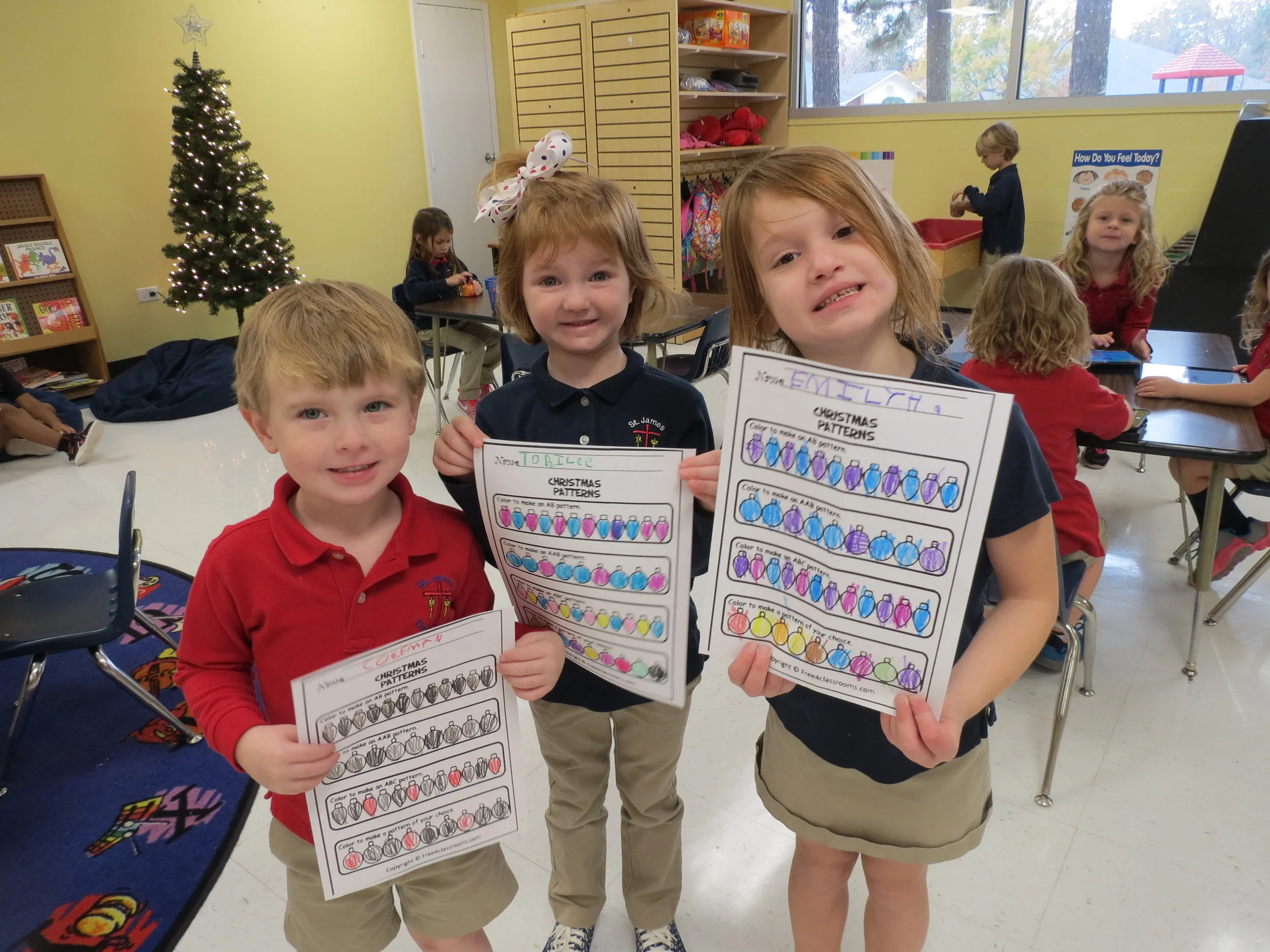
We worked on AB, AAB, and ABC Christmas patterns. Guiding children to understand patterns is a foundational skill in mathematics.  Children begin to identify patterns in their environment at an early age.  As they learn to label patterns by having one name stand for something else, they are creating an algebraic representation.

We put up our Christmas tree, and have been making our own ornaments.  The children painted their own Christmas tree and decorated it with pompoms.  They are very unique and are on display in our windows. 

I absolutely love teaching at St. James and being able to lead the little ones in a daily chapel and the Pledge of Allegiance.  What a great way to get your day started on a positive note!

I have been talking to the students about kindness.  The simple acts of kindness seem to go unnoticed in this world we live in.  The children were given the prompt “I can light up the world with kindness by…..” on a Christmas bulb.  They had to draw of picture of them performing an act of kindness and I transcribed their words onto the picture.   Activities like this are helping their emergent writing and critical thinking skills.  Writing originates from drawing and is supported by make-believe play.  Understanding the mechanics of the writing system has a moderate correlation with reading in the primary grades.  


Tracy Jones